Mobile · 2026
Hisplora
- Year
- 2026
- Scope
- Mobile · Academic
- Role
- iOS Developer, Product, and Content Research
- Team
- Team of 5
- Stack
- Swift, SwiftUI, SwiftData, Figma
- Status
- Completed
- Links
Location-based cultural heritage quests for first-time travellers.
A story-led cultural companion that turns a heritage visit into a walking quest. Travellers follow physical checkpoints, unlock lore at each stop, and finish with a shareable recap of the route.
Hisplora is a location-based cultural companion for travellers, not a tourist map and not a history encyclopedia, but a story-led experience. A quest strings together physical checkpoints such as a puri, a pura, a market, or a monument. At each stop the app unlocks lore, asks for a light task as proof of visit, and at the end produces a recap the traveller can keep or share.
Read moreShow less
The design came out of design-thinking research: interviews with domestic and international tourists plus a storyteller from Kultara. Two problems came up consistently. Heritage sites feel flat: travellers know a place is historic but not why, so the visit becomes a photo checklist. And the information that does exist is scattered and hard to trust: thin plaques, generic search results, and human guides who are not always available or suited to travellers who prefer to explore on their own.
The distinguishing mechanic is what the team called the history connector. Each site has a complete story that stands on its own, but visiting several sites along one quest route makes those stories link into a single narrative that moves through layers of time toward a historical climax. Because that ordering is the story logic (distant past, recent past, present, climax), checkpoints in a quest are strictly linear rather than an on-demand guide.
The worked example is "Jejak Terakhir Badung" in Denpasar: five checkpoints from Puri Pemecutan through Pura Maospahit, Pasar Badung, and Pasar Kumbasari to Catur Muka, roughly 2.2 km on foot. The narrative runs from the birth of the Pemecutan kingdom through Majapahit-era ancestry and everyday market life to the 1906 puputan, closing symbolically at Catur Muka. The route is not imaginary: a local cultural tour community walked it in 2025.
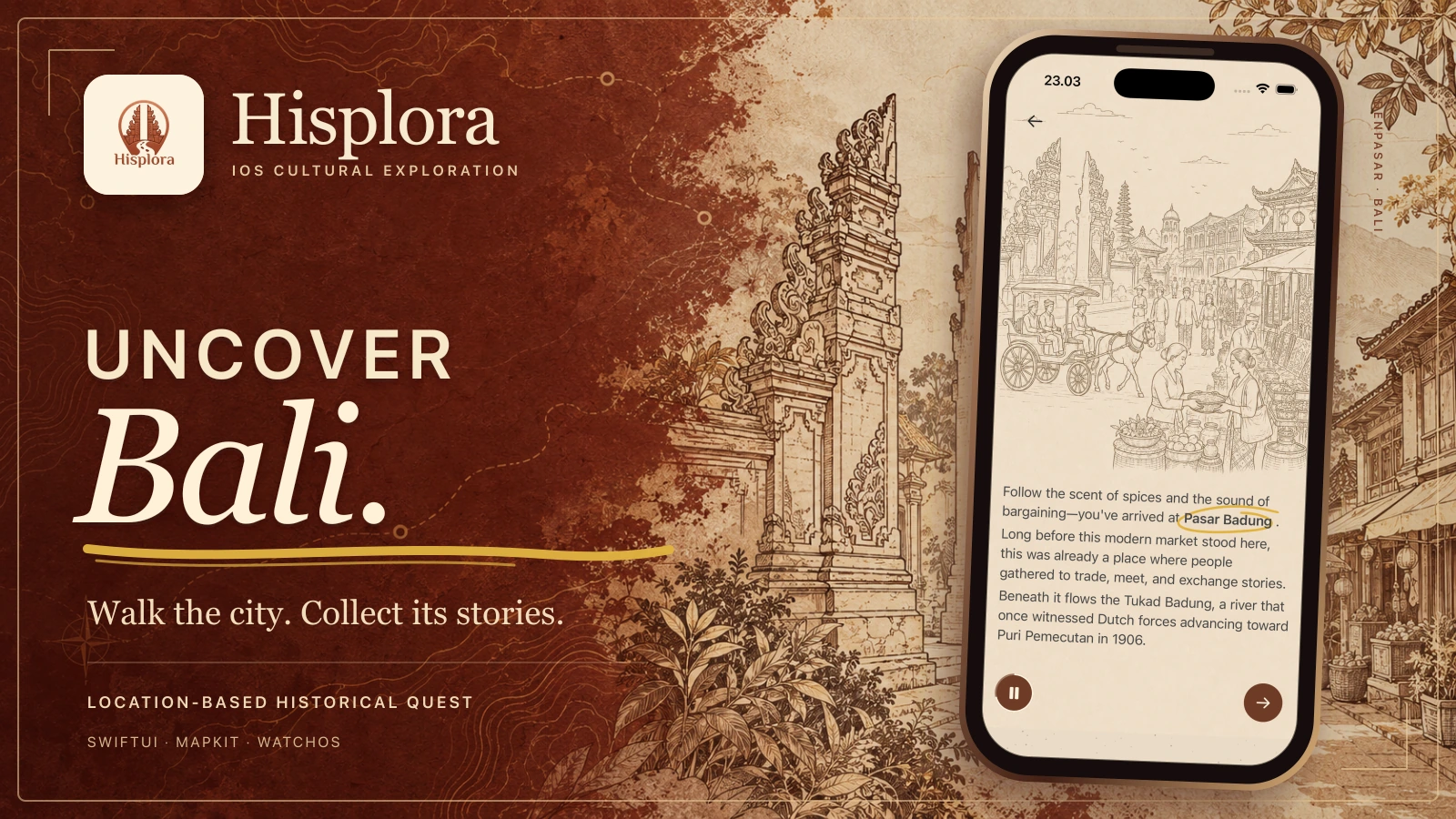
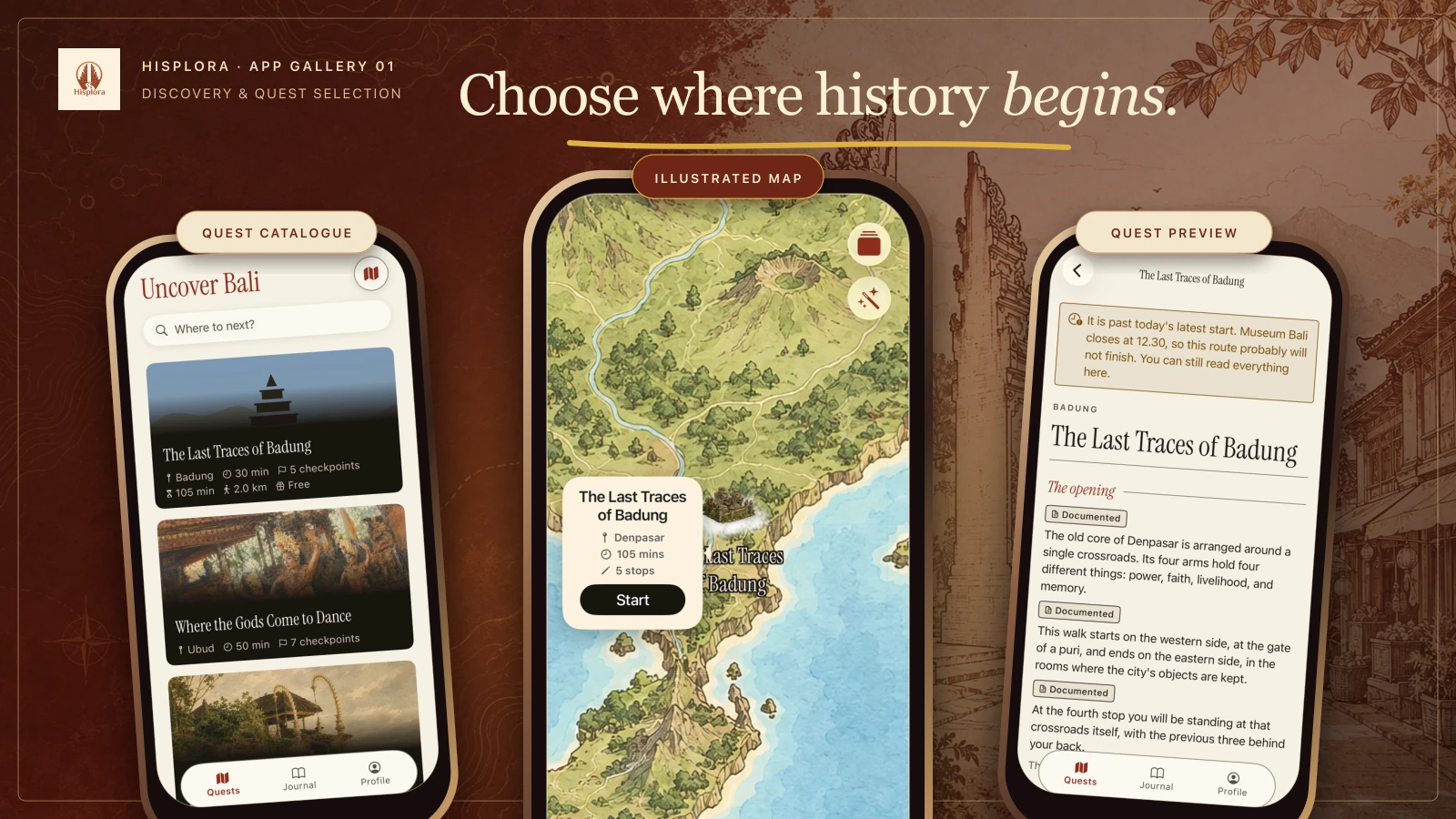
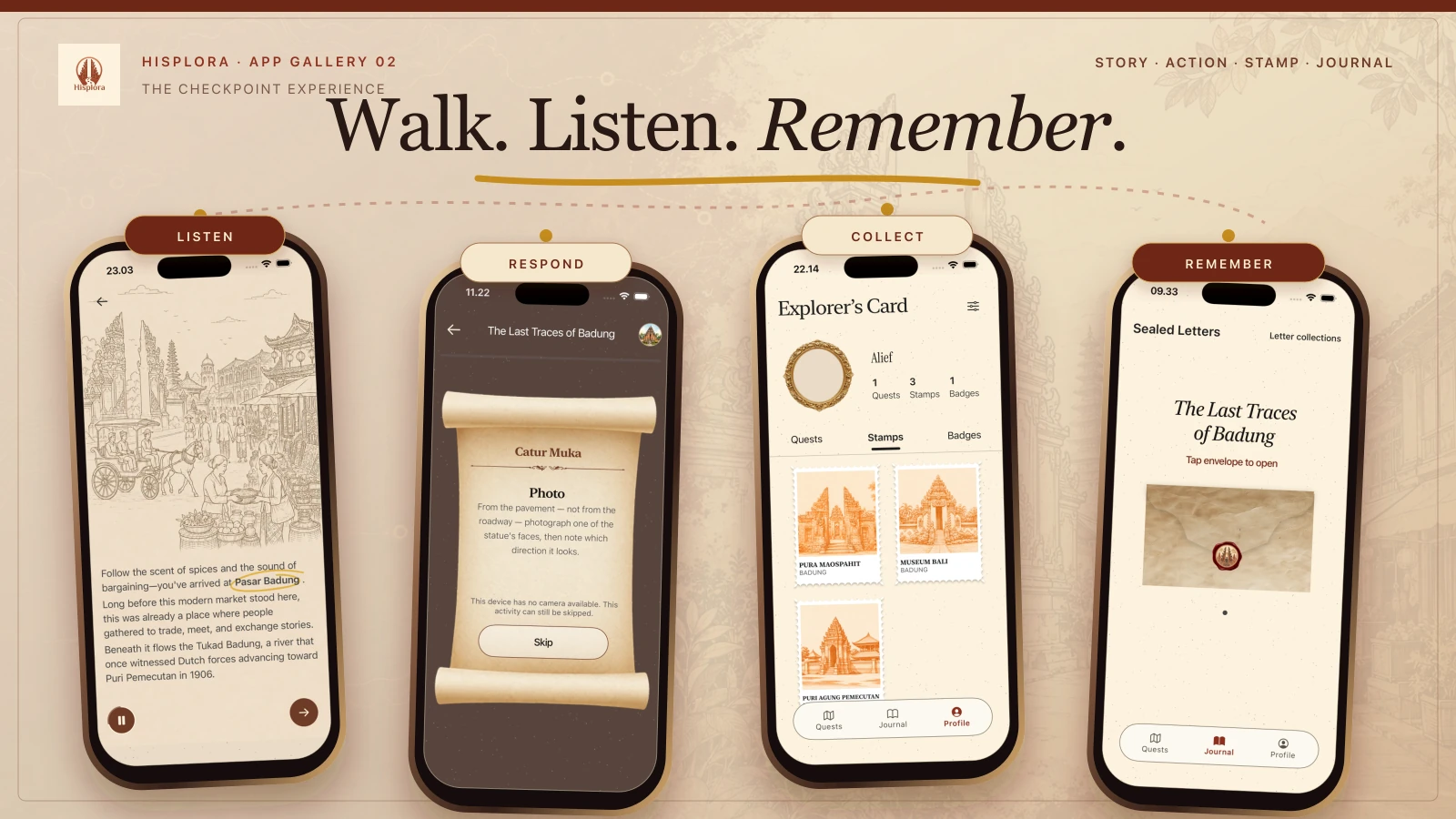
A location-based historical quest for walking through Bali and collecting its stories.
Brief
Problem
Cultural heritage often feels flat to first-time visitors: they know a place is historic but not its story, so the visit becomes a photo checklist. Existing information is fragmented and hard to trust, while human guides are not always available or suited to independent explorers.
Solution
Connect tangible sites to their intangible context (stories, traditions, historical events) through a linear walking quest where each checkpoint unlocks a layer of one larger narrative, with badges and a shareable recap as the payoff.
My role
- 01
Wrote the product overview: research synthesis, personas, user flows, feature specification, and technical direction
- 02
Researched and wrote the quest lore, including the "Jejak Terakhir Badung" route across five Denpasar checkpoints
- 03
Worked on the iOS application as part of a five-person team
Features
- 01
Map Area showing the quest region, recommended stops along the route, and collected badges
- 02
Three-phase quest system: opening lore and route preview, then clues and checkpoint tasks, then badges and a recap
- 03
Photo tasks as proof of visit at each checkpoint, plus optional side quests
- 04
Auto-composed "Wrapped"-style summary card ready to share to social media
- 05
Journal of the Place listing visited sites, per-quest trip summaries, and share history
- 06
History Alert: geofenced ambient notifications when passing a historic site outside an active quest
- 07
Draft saving so an unfinished quest can be resumed later
- 08
Checkpoint mechanics tuned to the character of each place
Architecture
Native iOS in SwiftUI with an MVVM structure. CoreLocation serves two different needs: a radius check that arms the start button inside an active quest, and background geofencing for the ambient History Alert. MapKit renders the map area, UserNotifications delivers the geofenced alerts, and SwiftData persists quest progress, drafts, and the journal.
- Front end
- Swift, SwiftUI
- Data
- SwiftData
- Tools
- Figma
- Integrations
- CoreLocation, MapKit, UserNotifications, PhotosUI, ShareLink
Challenges
- 01
Problem
Several checkpoints sit in active places of worship, where a loud, playful game mechanic would be inappropriate.
Solution
Split the mechanics by the character of the place: quiet and respectful at a puri or pura (photo, read the lore, one light question) and more interactive in public space such as markets and squares, with puzzles and scavenger tasks.
- 02
Problem
Every site needed a story that works alone for a casual visitor, yet the product's whole premise was that the stories connect.
Solution
Made each site standalone by default and treated the interconnection as an optional bonus layer that appears when several sites are visited on one route, with checkpoint order fixed because the order is itself the story logic.
Lessons
- 01
Lore drawn from public sources (official sites, local media, Wikipedia, interviews with caretakers) cannot ship as final fact. Specifics on the ground such as carvings, plaques, real opening hours, and prayer rules have to be validated in person first.
- 02
Walking distance has to be measured with real walking directions rather than a straight-line calculation with a buffer, or the route progress will not match what a visitor actually experiences.